GENDER
The independence of women to make decisions was a central theme in early debates on women’s suffrage. Later campaigns highlighted that women paid taxes and contributed to war efforts. In contrast, white men were assumed to be responsible due to their gender and race.
1776
The 1776 State Constitution of New Jersey gave the right to vote to all inhabitants of full age who met property and residence requirements.
Laws passed in 1790 and 1797 clarified this right belonged to women, talking about voters as "he or she." However, it was limited to propertied women who were single or widowed. Married women were legally dependent on their husbands.
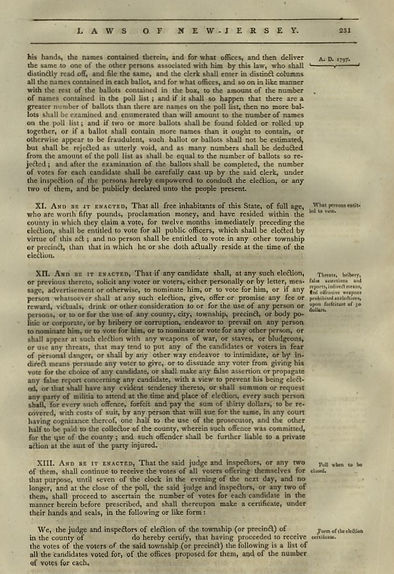
"...[N]o person shall be entitled to vote in any other township or precinct, than that in which he or she doth actually reside at the time of the election."
Act to Regulate the Election (1797)
New Jersey State Library
A recently discovered poll list from Montgomery, NJ, recorded the names of more than 40 women who voted in 1801.


New Jersey State Archives/Lars Harrison

New Jersey State Archives/Lars Harrison
New Jersey State Archives/Lars Harrison
Interview with Candy Willis/Lars Harrison
"If you were married, you were under something called coverture, which is the protection and authority of your husband... You couldn't vote. The only women who could vote were widows and single women. But they had to have 50 dollars proclamation money."
Candy Willis, Van Harlingen Historical Society, January 12, 2025
However, some argued that women were not fit to vote, because they did not know anything about politics.

"It is perfectly disgusting, to witness the manner in which women are polled at our elections. Nothing can be a greater mockery of this invaluable and sacred right, than to suffer it to be exercised by persons, who do not even pretend to any judgment on the subject."
William Griffith, Eumenes, No. VIII, p. 33 (1799)
New Jersey State Library
Others suggested that women were guided by men when casting their votes.

"Timid and pliant, unskilled in politics, unacquainted with the real merits of the several candidates, and almost always placed under the independence or care of a father, an uncle, a brother, &c. they will of course be directed or persuaded by them; and the man who brings his two daughters, his mother, and his aunt to the election, really gives five votes instead of one.”
Friend to the Ladies, True American, October 25, 1802
America's Historical Newspapers
1807
Some claimed that women used their vote irresponsibly. In 1807, an election in Newark and Elizabeth was spoiled by fraud. Newspapers largely blamed women for the corruption.

"Women and girls, black and white, married and single, without and without qualifications, voted again and again. And finally men and boys disguised as women voted once more, and the farce was complete.”
Edward Raymond Turner (1916)
HathiTrust
After this election, the state legislature adopted a new law establishing that the right to vote belonged only to free, white, male citizens, who had reached the age of 21.

"Whereas doubts have been raised, and great diversities in practice obtained throughout the state in regard to the admission of... females... to vote in elections... [F]rom and after the passing of this act, no person shall vote... unless such person be a free, white, male citizen of this state."
Supplement to the Act to Regulate Elections (1807)
New Jersey State Library
1867
The 1848 Seneca Falls Convention launched the women’s suffrage movement in the United States, declaring women’s right to equal status with men. This included the right to "no taxation without representation." In 1858, suffragist Lucy Stone moved to New Jersey and refused to pay her taxes in protest.
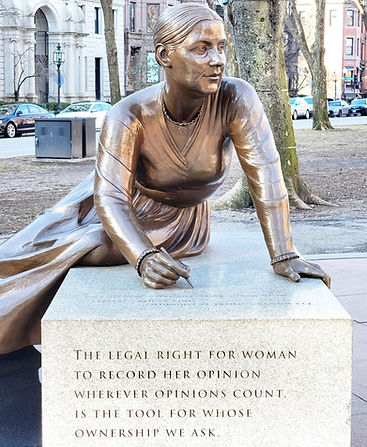
"Enclosed I return my tax bill, without paying it. My reason for doing so is that women suffer taxation and yet have no representation, which is not only unjust to one half of the adult population, but is contrary to our theory of government.”
Lucy Stone, Letter to Tax Collector (1858)
Only in Boston (@OnlyinBos) on X, March 8, 2022
In 1867, Stone founded the New Jersey Woman Suffrage Association. In a speech to the state legislature that same year, she emphasized women’s capacities and contributions as reasons to give them the vote.

"[The great majority of women are more intelligent, better educated, and far more moral than multitudes of men whose right to vote no man questions. Women are loyal and patriotic. During the late war, many a widow not only yielded all her sons to the cause of freedom, but strengthened their failing courage when the last good-bye was said.”
Lucy Stone, Address to NJ Legislature (1867)
HathiTrust
1915
The state legislature voted in 1914 and 1915 to grant full suffrage rights to women. A public referendum was required as a final step to amend the state constitution.
Supporters stressed that women were responsible citizens and it was time to extend this privilege to them.

"People Say: Women will not vote when they are given the right. We Say: Official figures show that women DO vote largely wherever they have the right.”
Women’s Political Union of New Jersey (1915)
Special Collections and University Archives, Rutgers University
This included President Woodrow Wilson, the former governor of New Jersey and president of Princeton University.

"I intend to vote for woman suffrage in New Jersey because I believe that the time has come to extend that privilege and responsibility to the women of the States.”
President Woodrow Wilson (1915)
Special Collections and University Archives, Rutgers University
Opponents questioned women's willingness to hold this responsibility, however.

"Conferring on the women who claim it would impose suffrage upon the many women who neither desire it as a privilege nor regard
it as a duty."
New Jersey Association Opposed to Woman Suffrage (1915)
Amelia Berndt Moorfield Collection, New Jersey Historical Society
The suffrage amendment was ultimately defeated by a margin of over 51,000 votes.

Library of Congress

njwomenshistory.org
1920
Both houses of the U.S. Congress voted in favor of women’s suffrage in 1919. In February 1920, New Jersey became the 29th state to ratify the 19th Amendment.

"The right of citizens of the United States to vote shall not be denied or abridged by the United States or by any State on account of sex."
Senate Concurrent Resolution No. 1 (1920)
New Jersey State Archives