RACE
Free Blacks were among the first voters in New Jersey. Freedom was seen as an important qualification for Black voting rights. Later efforts to remove racial barriers stressed civil rights and how suffrage would elevate Blacks as citizens.
1776
The 1776 State Constitution of New Jersey gave the right to vote to all inhabitants of full age who met property and residence requirements. Laws in 1790 and 1797 revised this language to clarify that slaves could not vote as they were not independent.
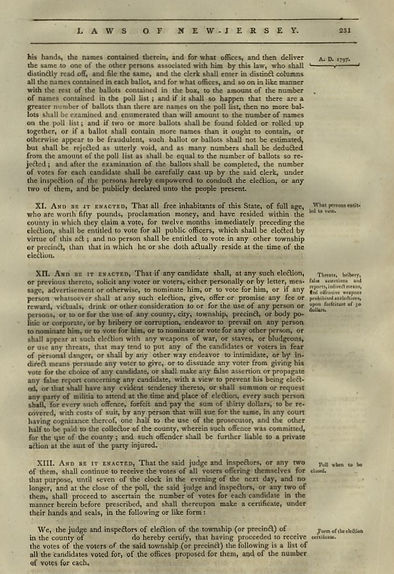
"All free inhabitants of this State, of full Age, who are worth fifty pounds, proclamation money, and have resided within the county in which they claim a vote for twelve months immediately preceding the election, shall be entitled to vote."
Act to Regulate the Election (1797)
New Jersey State Library
An 1801 poll list from Montgomery, NJ, includes one name, Ephraim Hagerman, marked as “negro.” Research on tax records in the township suggests that at least three more names on the list were people of color.
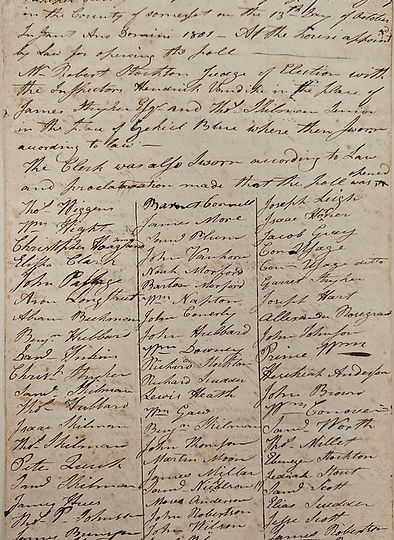
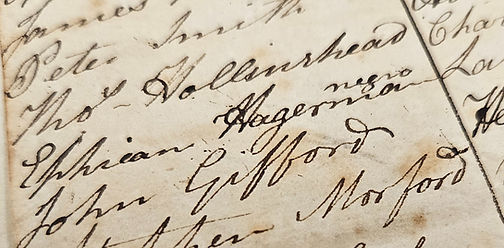
New Jersey State Archives/Lars Harrison
New Jersey State Archives/Lars Harrison
1807
Accusations of voter fraud in early elections included claims that slaves had voted.
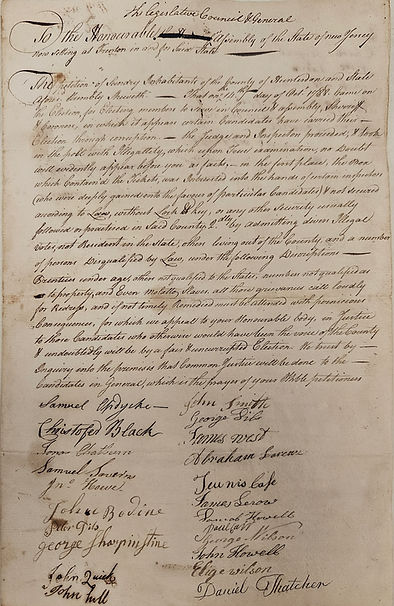
"The Judge & Inspector proceeded... by admitting divers Illegal voters... Even molatto [sic] Slaves."
Petitions of Inhabitants of Hunterdon County (1787)
New Jersey State Archives/Lars Harrison
Due to doubts about who was eligible to vote, the state legislature changed the law to state that this right belonged only to free, white, male citizens over the age of 21.
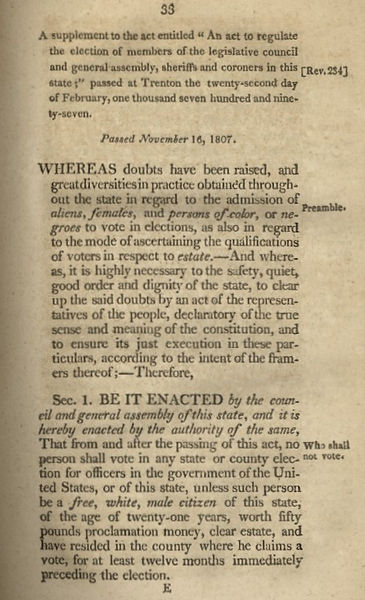
"Whereas doubts have been raised, and great diversities in practice obtained throughout the state in regard to the admission of... persons of color, or negroes to vote in elections... [F]rom and after the passing of this act, no person shall vote... unless such person be a free, white, male citizen of this state."
Supplement to the Act to Regulate Elections (1807)
New Jersey State Library
These restrictions also appear in the 1844 State Constitution of New Jersey.

"Every white male citizen of the United States, of the age of twenty-one years, who shall have been a resident of this State one year, and of the county, in which he claims his vote five months, next before the election, shall be entitled to vote."
New Jersey Constitution, Article II (1884)
Department of State, New Jersey
1850
Following petitions in support of Black suffrage, the State Assembly Judiciary Committee recommended amending the 1844 State Constitution to remove the word "white."

"[A]n amendment to the Constitution of this State… is proposed, by which the word 'white' shall be erased from the first section of the second article thereof, entitled, 'right of suffrage.'"
Minutes of the 74th General Assembly (1850)
HathiTrust
The committee argued that race should not restrict a person's right to vote.
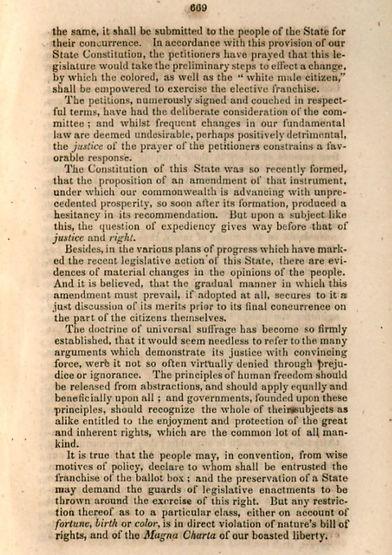
"It is true that people may, in convention, from wise motives of policy, declare to whom shall be entrusted the franchise of the ballot box.. But any restriction [of the franchise] as to a particular class, either on account of fortune, birth or color, is in direct violation of nature’s bill of rights.”
Minutes of the 74th General Assembly (1850)
HathiTrust
They also proposed that the vote would create opportunities for Blacks to become responsible citizens.
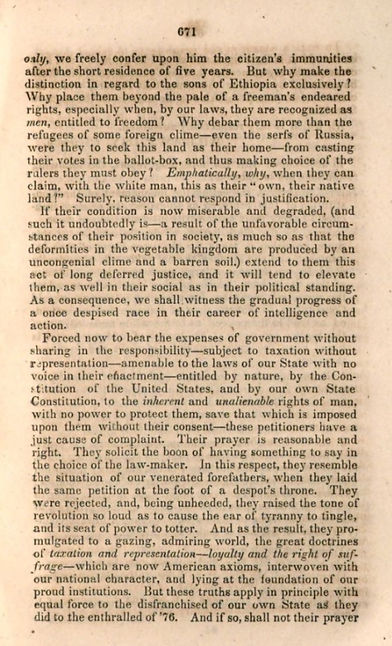
"[E]xtend to them this act of long deferred justice, and it will tend to elevate them, as well in their social as in their political standing. As a consequence, we shall witness the gradual progress of a once despised in their career of intelligence and action."
Minutes of the 74th General Assembly (1850)
HathiTrust
1868
After the Civil War, Republicans in the New Jersey state legislature reaffirmed their commitment to removing the word "white" from the state constitution. The Democrat-dominated legislature, however, rejected this proposal as irresponsible.
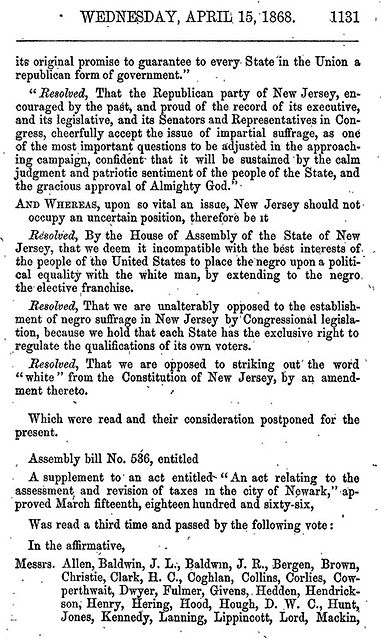
"[W]e deem it incompatible with the best interests of the people of the United States to place the negro upon a political equality with the white man, by extending to the negro the elective franchise."
Minutes of the 92nd General Assembly (1868)
New Jersey State Library
1870
In 1869, the U.S. Congress passed the 15th Amendment prohibiting the denial of suffrage based on race, color, or previous condition of servitude. Although the New Jersey state legislature refused to ratify it, the amendment came into force in 1870. They later ratified it in 1871.

"The right of citizens of the United States to vote shall not be denied or abridged by the United States or by any State on account of race, color or previous condition of servitude."
Joint Resolution No. 2, State of New Jersey (1871)
Department of State, New Jersey
The day after the 15th Amendment came into effect, a special election was held in Perth Amboy and Thomas Mundy Peterson became the first Black man to exercise his right to vote under the amendment. The city of presented him with a medal in 1884.
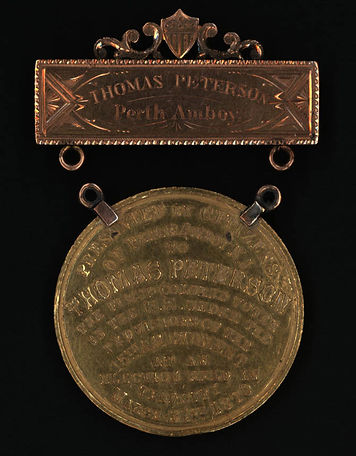
"Presented by the citizens of Perth Amboy, NJ, to THOMAS PETERSON, the first colored voter in the U.S. under the provisions of the 15th Amendment at an election held in that city March 31st 1970."
Medal presented to Peterson on May 30, 1884
Xavier University of Louisiana Library
Digital Archives & Collections
Peterson took his rights as a voter seriously, even when it might have been dangerous to vote as a Black man.
Interview with Gordon Bond/Lars Harrison
"When they gave him the voting medal in 1884, they were pinning a medal to a man's coat for doing something that, in another part of the country, they would have been putting a noose around his neck."
Gordon Bond, Garden State Legacy, January 19, 2025
1875
The State Constitution of New Jersey was later amended to remove the race requirement for suffrage.
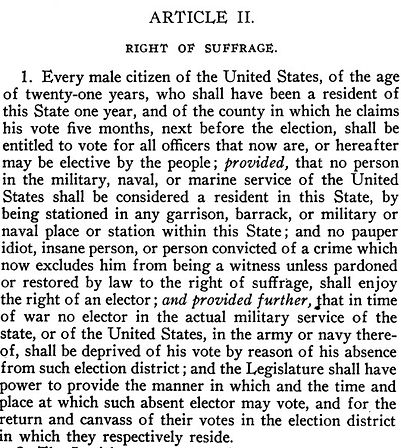
"Every male citizen of the United States, of the age of twenty-one years, who shall have been a resident of this State for one year, and of the county in which he claims his vote five months, next before the election, shall be entitled to vote."
New Jersey Constitution, Article II (amend.1875)
HathiTrust